

 русский
 Español
The company relies on a high degree of brand awareness, fine product quality, convergence of multiple strong advertising media power, and through the integration of capital, knowledge, talent technology, channels, information operations.
There is a small moment in baking that can cause quite a bit of frustration. The cake is out of the oven, the kitchen smells wonderful, and everything seems to have gone according to plan. Then comes the job of getting it out of the pan. The edges stick, the bottom refuses to come away, or a carefully baked tart cracks just when it is being transferred to a plate.
Anyone who makes cakes regularly has probably dealt with this at some point.
The problem is not always the recipe. Sometimes, the pan itself makes removal harder than it needs to be. A Removable Bottom Cake Pan is designed with this situation in mind. Its separate base allows the baker to release the outer ring without having to pull the entire dessert out of the container.
This is especially useful when the finished product has a delicate crust or needs to keep its shape for presentation. Still, the design is not suitable for every recipe, and there are a few details worth understanding before choosing one.
The Baking Is Done. Why Is Getting the Cake Out Still a Problem?
A cake changes quite a bit between the moment it enters the oven and the time it is ready to serve. Heat sets the batter, moisture gradually escapes, and the ingredients form the texture we recognize as a finished bake.
During this process, the mixture takes the shape of the pan. Some areas may remain attached to the metal surface, particularly around the base and edges.
With a fixed-bottom pan, the baker has to find a way to release the entire cake from the container. That might be easy with a firm sponge cake, but it becomes less straightforward with a thin pastry shell or a soft filling.
A few situations come up regularly:
- The pastry edge breaks when the cake is lifted.
- Part of the bottom remains attached to the pan.
- A soft dessert loses its shape during turning.
- The finished product needs extra handling before it can be served.
For a home baker, this can mean an untidy dessert. In a bakery, it may also mean spending extra time preparing products for display.
That is where the construction of the pan starts to matter.
What Actually Happens When the Bottom Can Be Removed?
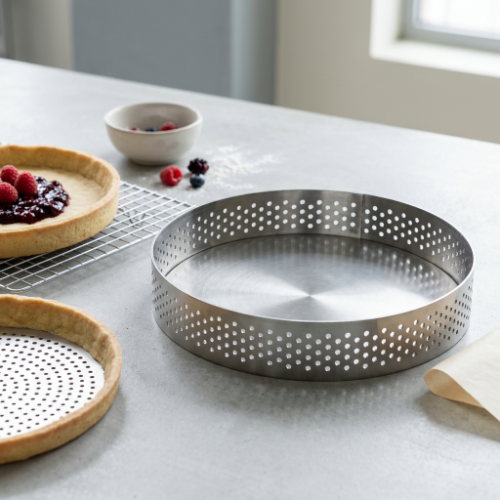
Look at the structure of a removable-bottom pan and the idea becomes quite easy to understand. There are two main parts: the surrounding ring and a separate base plate.
The ring holds the mixture in place and forms the sides of the baked product. The base supports the batter or pastry during baking.
Once the food has cooled, the components can be separated. Depending on the design, the base may be pushed upward, or the outer ring may be lifted away.
The useful part is what happens next. Instead of trying to pull a whole cake out of a deep container, the baker can leave it resting on the base while removing the surrounding metal ring.
This is a different approach to cake release, and it can make handling less awkward.
Why Does This Matter for Delicate Pastry?
A tart is a good example.
The crust usually has a bottom and a raised edge. Once baked, it needs to remain intact while the filling and toppings are added. If the baker has to turn the whole pan over, the pastry may crack under its own weight or from uneven pressure.
With a removable base, the sides can be released while the pastry stays supported underneath.
It does not mean the crust cannot break. Overbaking, handling while hot, or an unsuitable recipe can still cause problems. The design simply removes one of the unnecessary steps involved in releasing the food.
Where Does This Pan Design Come in Handy?
Not every baking task calls for a detachable base. A regular cake mold works well for plenty of everyday recipes.
The difference is easier to see with foods that need a little extra care after baking.
Fruit Tarts: Keeping the Crust in Shape
Fruit tarts are often prepared with a pastry shell that is baked before the filling is added. Once the crust has cooled, it needs to be removed without damaging the edges.
This is one reason loose-bottom tart pans are commonly used for this type of preparation. The outer ring can be separated, leaving the pastry accessible for filling and decoration.
For bakeries that prepare several varieties of tarts, being able to handle the shell without repeatedly touching its sides is a practical consideration.
Cheesecakes: A Different Texture, a Different Requirement
Cheesecake presents another situation. Its filling is generally softer than that of a conventional sponge cake, and it may need to settle before removal.
A removable-bottom pan can be useful for some cheesecake recipes, but the joint between the base and ring should not be overlooked. If the mixture is thin before baking, it may escape through a gap.
This is why some bakers prefer springform pans for particular cheesecake recipes. The two designs have different closure mechanisms, so choosing between them should depend on the mixture and the intended result.
Quiches and Savory Pastries
Sweet baking is not the only application.
A vegetable quiche or savory tart also has a base that needs to stay intact when moved from the pan to a serving plate. Separating the outer ring can make that step easier.
For kitchenware retailers, this gives the product a wider application than its name might suggest.
Removable Bottom or Fixed Bottom: Which One Makes Sense?
It is tempting to assume that a removable base is always more convenient. In practice, both designs have their place.
A fixed-bottom pan has a simpler structure and works well for many everyday baking tasks. A separate base offers another removal method, but the connection between its components needs to be suitable for the recipe.
| Detail | Removable Bottom Pan | Fixed Bottom Pan |
|---|---|---|
| Construction | Separate base and outer ring | One connected structure |
| Removing baked goods | Ring and base can be separated | Cake needs to be released from the pan |
| Handling delicate pastry | Can reduce direct handling of the sides | May require extra care |
| Cleaning | Components can be washed separately | Usually cleaned as one piece |
| Recipe considerations | Base fit needs attention | Depends on pan shape and preparation |
The choice is not really about one design replacing the other. It is about having the right pan for the job.
How Is a Springform Pan Different?
These two products are sometimes grouped together because both help with releasing baked goods. Their structures, however, are not the same.
A removable-bottom pan has a separate base that sits inside the outer ring. A springform pan has a sidewall that can be opened by releasing a latch.
| Detail | Removable Bottom | Springform |
|---|---|---|
| Main structure | Separate base plate | Locking sidewall and base |
| How it opens | Base and ring are separated | Sidewall expands |
| Common use | Tarts and selected cakes | Cheesecakes and delicate cakes |
| Point to check | Fit between the two components | Latch and closure |
For buyers planning a baking product range, it is worth keeping these differences clear. They may look similar in a product catalogue, but customers often choose them for different reasons.
What Should You Look at Beyond the Removable Base?
The base mechanism gets much of the attention, but it is not the only thing that determines whether a pan is suitable.
Material, forming quality, surface treatment, and general construction all play a part.
Material and Surface Treatment
Carbon steel is widely used in metal bakeware. It can be formed into different shapes and is used for products ranging from cake molds to baking trays.
The surface finish is another consideration. A nonstick coating can help baked food separate from the pan, although the result still depends on the recipe and preparation method.
A coating does not mean the baker can ignore basic care. Using unsuitable metal utensils or abrasive cleaning materials may damage the surface over time.
For buyers sourcing bakeware, it makes sense to discuss the intended application and care requirements rather than selecting a product based on appearance alone.
The Fit Between the Base and Ring
This is a detail that deserves more attention than it usually receives.
The base needs to sit properly within the surrounding ring. If the fit is too loose, some mixtures may pass through the joint. If it is too tight, removing the components may become inconvenient.
A product should be checked as an assembled unit, not simply as two separate metal parts.
For manufacturers, this means paying attention to forming, edge finishing, and the fit of the finished components.
What Do Kitchenware Buyers Need to Consider Before Ordering?
For a distributor or importer, choosing a baking pan involves more than deciding whether it looks suitable for a product catalogue.
The intended customers matter. A retailer selling household kitchenware may be interested in different shapes and packaging from a supplier serving professional bakeries.
Before placing an order, buyers can discuss a few practical points with the manufacturer.
Product Construction
Ask how the bottom plate connects with the outer ring and how the assembled product is inspected. It is also worth confirming which recipes the design is intended to accommodate.
Material and Coating
Discuss the metal material, surface treatment, care instructions, and intended baking applications. These details should match the requirements of the market where the product will be sold.
Product Assortment
Consider whether the range should include different pan shapes and styles. A combination of tart pans, cake molds, and conventional baking trays may serve a wider group of customers.
Packaging and Customization
For OEM and ODM orders, packaging, labeling, product appearance, and other customization details can be discussed before production. Clear specifications make the process easier for both sides.
What Goes Into Making a Removable Bottom Pan?
A removable-bottom pan has more than one component, which means the production process needs to consider how the parts work together.
The two components have to work together. Their edges, shape, and assembly fit all influence how the finished pan feels in use.
| Area | Manufacturing Consideration |
|---|---|
| Metal forming | Consistency of the base and outer ring |
| Edge finishing | Smoothness and uniformity |
| Component fit | Ease of assembly and removal |
| Surface treatment | Coating condition and appearance |
| Finished product inspection | Performance of the assembled components |
| Packaging | Protection during storage and delivery |
A pan can look fine in a photograph but still be inconvenient if the base does not fit properly. That is why checking the assembled product is an important part of quality control.
For kitchenware suppliers, these details also provide useful information when comparing products from different manufacturers.
A Few Questions Buyers and Bakers Often Ask
Does a Removable Bottom Cake Pan Stop Cakes from Sticking?
No. The separate base makes removal easier, but it does not prevent ingredients from sticking to the surface. Proper preparation, coating condition, and cooling still matter.
Can It Be Used for All Types of Cake Batter?
Not necessarily. Thin mixtures may pass through the connection between the base and ring. Check the product instructions and choose a design that suits the recipe.
Should the Cake Be Removed While It Is Still Warm?
Usually, allowing the baked item to cool first makes handling easier. A warm cake may not have developed enough structure to withstand removal.
Is a Nonstick Finish Necessary?
It depends on the product design and intended use. A nonstick surface can help with release, but the preparation method should still follow the recipe and manufacturer's instructions.
Can the Base Be Used as a Serving Plate?
Some designs allow the baked item to remain on the base after the outer ring is removed. Whether it is suitable for serving depends on the construction and product instructions.
Choosing Bakeware Starts with Understanding How It Will Be Used
A removable base may seem like a small feature, but it addresses a problem that bakers encounter at the end of the baking process. Instead of struggling to lift a delicate cake or tart out of a complete pan, they can separate the surrounding ring and leave the baked item supported.
That is the practical reason behind this design.
For kitchenware buyers, the details worth checking are not limited to the appearance of the pan. The fit of its components, material, surface treatment, and intended recipes all deserve attention.
Befair Kitchenware works with businesses looking for bakeware and metal kitchenware products. Buyers interested in developing a product range can explore the company's baking pan collection and discuss their sourcing or customization requirements.
A baking pan is used throughout preparation, baking, and removal. Looking at all three stages gives buyers a clearer idea of what makes a product suitable for their customers.