


 русский
 Español
The company relies on a high degree of brand awareness, fine product quality, convergence of multiple strong advertising media power, and through the integration of capital, knowledge, talent technology, channels, information operations.
When people search for microwave baking tray price , the question behind it is usually more practical than it looks. It's rarely just about finding the lowest number. More often, it's about figuring out why prices don't look consistent, and what really matters when choosing between options.
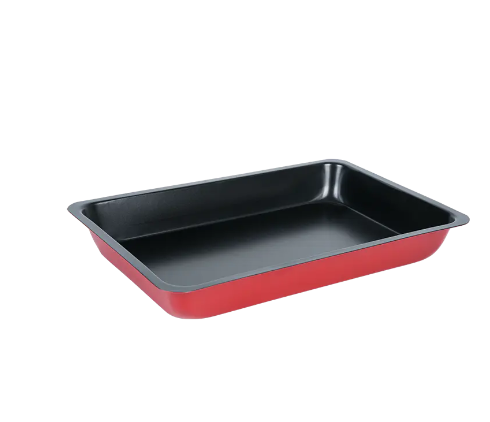
Walk through any online marketplace or supplier catalog, and you'll notice something quickly—two trays that seem almost identical can sit at very different price points. That gap isn't random. It reflects how the product is made, how it's sold, and how it's expected to be used.
Why the same product category feels so different in price?
At a glance, a microwave baking tray is a straightforward item. Flat surface, simple structure, no complicated moving parts. But once it enters the market, it becomes part of a much larger system—production, packaging, shipping, and positioning.
Some trays are made for occasional use, something you pull out once in a while. Others are designed to stay in daily rotation, used multiple times a day without much thought. That difference alone can quietly influence pricing.
There's also the way products are presented. A tray sold as a basic utility item will be priced differently from one positioned as a more refined kitchen accessory, even if their core function is similar.
Looking at price through everyday use
Instead of starting with numbers, it helps to think about how the tray will actually be used.
Imagine two different households:
- One uses the microwave once or twice a day, mainly for reheating
- Another relies on it heavily for quick meals, snacks, and daily cooking shortcuts
In the first case, a simpler tray may feel completely sufficient. In the second, durability and ease of handling become more noticeable over time.
So the price question slowly turns into a usage question. Not "how much does it cost?" but "how often will it be used, and in what way?"
The quiet factors behind pricing
There are a few underlying elements that tend to shape pricing, even if they're not always visible at first glance.
Material feel and long-term use
Some trays are lighter and more flexible, others feel firmer and more stable. This doesn't always show clearly in pictures, but it affects how the tray behaves after repeated heating cycles.
Production approach
Factories don't all follow the same process. Some focus on speed and volume, while others pay more attention to finishing details. This difference often shows up subtly in edges, surfaces, and overall consistency.
Design details
Even small adjustments—slightly raised edges, smoother surfaces, or a more balanced shape—can influence how the tray is used daily. These details may seem minor, but they contribute to how the product is valued.
A simple way to understand price variation
| Aspect | More Basic Option | More Refined Option |
|---|---|---|
| Feel in hand | Lightweight, simple | More solid, stable |
| Surface finish | Functional | Smoother, more uniform |
| Usage frequency | Occasional | Frequent, repeated use |
| Design details | Minimal | Slightly enhanced usability |
This isn't about labeling one as better than the other. It's about matching the product to the situation.
Retail price vs factory price: why the gap exists
One of the most common surprises for buyers is the difference between retail pricing and factory pricing, especially when sourcing from China.
At the retail level, the product has already passed through several layers—distribution, packaging, storage, and marketing. Each step adds cost.
At the factory level, pricing is closer to production reality. It reflects materials, labor, and manufacturing efficiency, without many of the added layers.
| Channel | How price is formed | Typical buyer |
|---|---|---|
| Retail | Includes packaging, branding, logistics | Individual users |
| Wholesale | Based on order volume | Importers, resellers |
| Direct factory | Negotiated, volume-driven | Bulk buyers |
| Design details | Minimal | Slightly enhanced usability |
This is why the same tray can appear to have a wide price range depending on where you look.
The role of order quantity
Quantity plays a bigger role than many people expect. A single tray and a bulk order are treated very differently in pricing discussions.
Factories are usually structured around volume. Larger orders allow for more efficient production planning, which often leads to lower unit costs. Smaller orders, on the other hand, may involve higher per-unit expenses because the setup effort is similar regardless of scale.
This doesn't just affect price—it also affects how suppliers approach the transaction.
How packaging and shipping quietly add to cost?
Sometimes the product itself isn't the main driver of price differences. Packaging and logistics can shift the final number more than expected.
A tray packed simply for local distribution may cost less overall than one prepared for long-distance shipping with added protection. When exporting, packaging often becomes more robust, and shipping conditions introduce additional considerations.
These factors are rarely the first thing buyers think about, but they are always present in the final price.
Is the lowest price the safest choice?
It can be tempting to focus only on the lowest available price, especially when products look similar. But in practice, the lowest price doesn't always lead to the smoothest experience.
A tray that feels fine at first may behave differently after repeated use. Small inconveniences—like slight warping, uneven surfaces, or handling discomfort—tend to show up over time rather than immediately.
That doesn't mean higher-priced options are always necessary. It simply means price should be viewed together with usage expectations.
How buyers usually make decisions?
In real buying situations, especially for sourcing, decisions often follow a pattern:
Initial focus on price
- Comparison between options
- Consideration of use and durability
- Adjustment of expectations
- Final balance between cost and practicality
This process is not always linear, but it reflects how people move from a simple question to a more informed choice.
The influence of China in global pricing
China's role in kitchenware production makes it a central point in pricing discussions. Large manufacturing capacity allows for a wide range of options, from very basic to more refined.
This creates flexibility:
- Entry-level products for cost-focused buyers
- Mid-range options for everyday use
- Slightly higher-end variations for more frequent use
Because of this range, buyers are not locked into a single price level. They can adjust based on their needs without stepping outside the category.
A practical way to evaluate price
Instead of treating price as the starting point, it can be helpful to approach it from another angle:
- Think about how often the tray will be used
- Consider whether it will be part of daily routine or occasional use
- Look at consistency rather than just first impressions
- Balance short-term savings with long-term convenience
This way, price becomes part of a broader decision rather than the only factor.
The topic of China Microwave Baking price is less about a fixed range and more about understanding context. What looks like a simple product is shaped by many small decisions—materials, production, usage, and distribution.
In everyday kitchens, the tray itself doesn't try to stand out. It simply supports daily tasks quietly. And in the same way, its price is not defined by a single rule, but by how it fits into real use.
Finding the right option is not about chasing the lowest number. It's about choosing something that works naturally in the rhythm of daily life.